
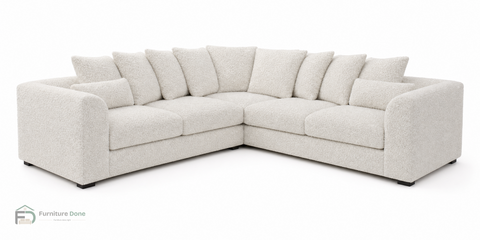
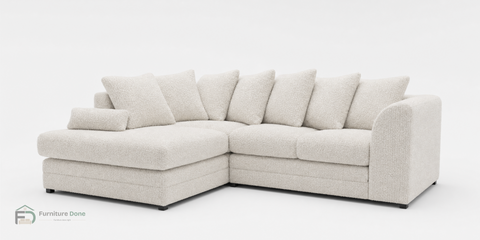
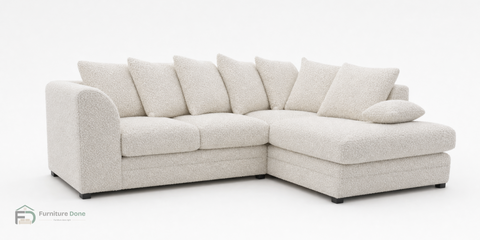

L shaped or U shaped sofa: which is right for your room?
Share
Choosing an L shaped or U shaped sofa usually comes down to one question: how many sides of the room do you want the sofa to take? An L takes two. A U takes three. Everything else — the walls, the door, how many people sit down at once — follows from that.
This guide is about the shape only. If you have already settled on a U and want to know how to measure for one, or how our two U shapes compare, our U shaped sofa buying guide covers both.
What an L shaped sofa is
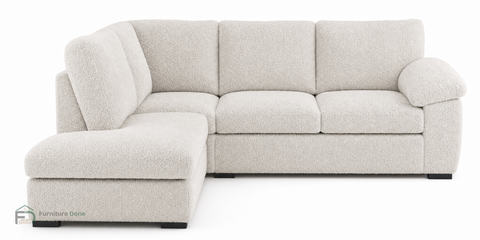
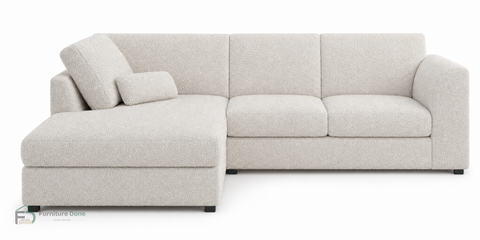
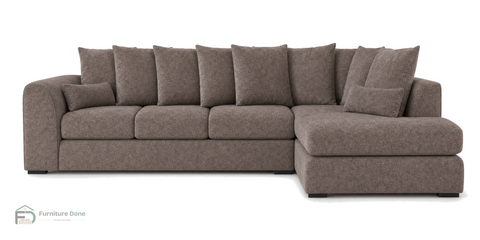
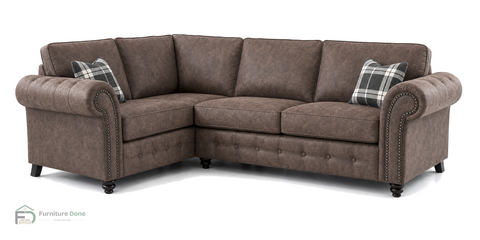
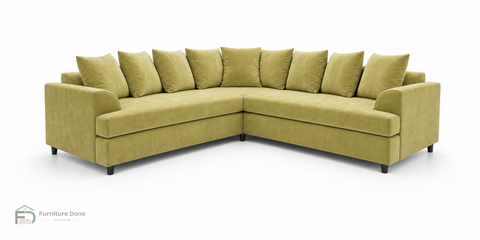
An L shaped sofa is a corner sofa — the two names mean the same piece. It has one long run and a return at one end, the two meeting at a right angle. Where the return is shorter than the main run, it sits on the left or the right — that is the sofa's hand. A symmetrical L has an equal run on both sides and no hand to choose.
Either way, an L is built to tuck into a corner of the room, or to sit along one wall with the return marking an edge. It leaves two sides of the room free.
What a U shaped sofa is
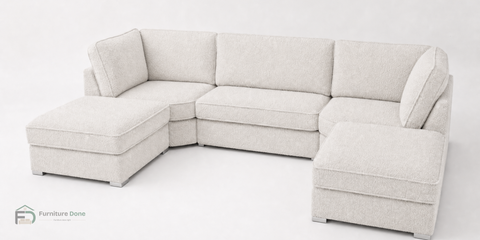
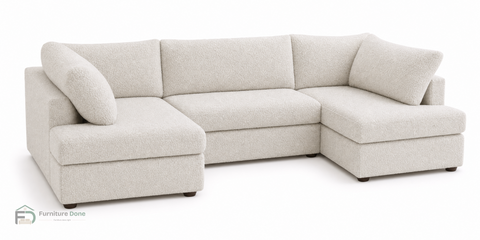
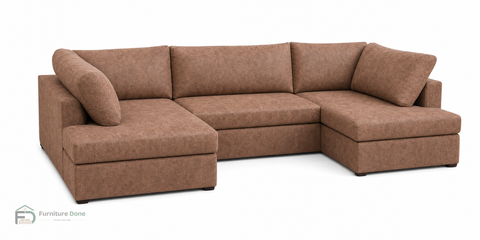
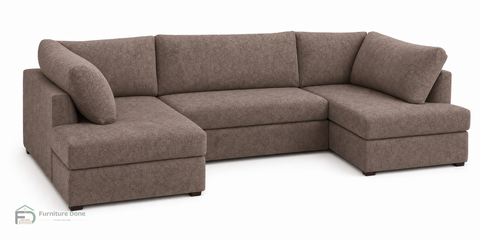
A U shaped sofa is a long run with a chaise returning forward at both ends. It seats the room from three sides instead of two, so the space in the middle — a footstool, a coffee table, the rug — becomes the centre of the room. Because both ends match, a U has no hand: it works the same way round either way.
The trade-off is floor. A U reaches into the room down both sides, so it needs clearance past both chaises and a clear way in at the open end.
U shape vs L shape sofa: which suits your room?
There is no right answer in the abstract, only the right answer for your room — and it usually comes down to four things.
The shape of the room
A boxy room with a natural corner suits an L. It fills the corner, keeps the seating against two walls and leaves the rest of the floor open. A long, narrow room usually suits an L too, set along the long wall with the return closing off one end. A narrower room can still take a U — that is where our smaller London comes in — as long as the walkway past each chaise stays clear.
A large, squarish room is where a U comes into its own. Against the main wall or floating in the middle, it makes a defined seating area rather than a sofa pushed to the side.
Doors, windows and walkways
Mark every door, window, radiator and walkway on a sketch of the room, then try each shape on it.
- An L is more forgiving around a door. Choose the hand that keeps the return away from it.
- A U needs both ends free. If a door or walkway sits where either chaise would land, it is the wrong shape for that wall.
- Think about which way it faces. A U faces one way — the TV, the fire or the view. An L faces two, which suits a room whose focus is in a corner.
How many people sit down at once
Count the people on an ordinary evening, not at Christmas. If it is usually one or two of you, an L gives you a corner to settle into and a return for one person to put their feet up. A U gives you a chaise at each end, so two people can stretch out and the rest still have the middle — the shape for a household that regularly has more people round than one sofa takes.
Open-plan or a closed room
In an open-plan space, a sofa often has to do the job of a wall. A U does that well: its back can face the kitchen or the dining table while it encloses the living area in front of it. An L can zone a space too, with its back to the room and the return marking the edge, and it leaves a wider gap to walk through.
In a closed room with one door, ask whether it can take a return on both sides and still let you walk in. If not, it is an L.
Corner sofa or U shaped sofa: getting the hand right
Whether you go for an L shape or U shape sofa, only the L asks you to pick a side. The hand is the side the return sits on as you look at the sofa from the front — not as you sit on it, which is the easy way to get it backwards. Picture the sofa from the front, as in a product photo, and put the return on the side the room has space for. Our left-hand or right-hand corner sofa guide walks through it, with a quick check that catches most mistakes.
If you would rather not choose a hand at all — because the room could take either, or because you may move — a symmetrical corner or a U shape sidesteps the question.
A quick way to decide
- Does the room have a corner the sofa can tuck into, with the door elsewhere? L.
- Is the room long and narrow? L, along the long wall.
- Is the room large and squarish, or open-plan, with space to walk round both ends? U.
- Do two or more people regularly want to put their feet up at once? U.
- Would a chaise at either end block a door, a window you open or a walkway? L.
- Unsure which way round the room runs, or likely to move? A symmetrical corner or a U.
Then test it on the floor before you order — the tape test in our U shaped sofa buying guide works for either shape. Our measuring guide covers the route in, and how to measure your room for a corner sofa takes an L step by step.
Our L and U shapes
Every sofa we sell is made to order in the UK, and you choose the fabric and colour on each sofa's own page.
- L shape sofas — five corner sofas, with main runs from 202 cm on the Ferguson to 315 cm on the Oakland Large Corner. All but the Ferguson are made left-hand, right-hand or symmetrical; the Ferguson is symmetrical only. Browse by hand: left hand, right hand or symmetrical.
- U shape sofas — the London at 279 cm wide and the Bishop at 330 cm, both symmetrical, so there is no hand to choose.
Start with the room, then the shape, then the sofa.