
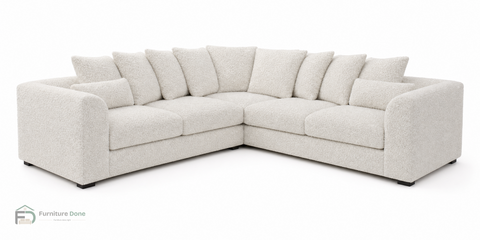
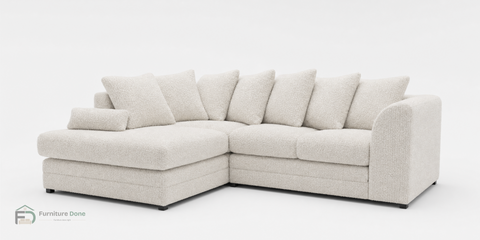
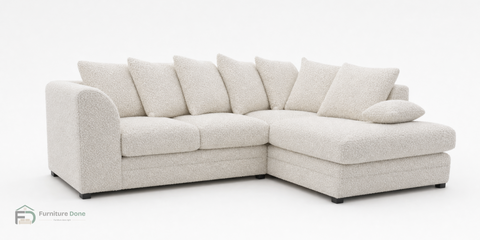
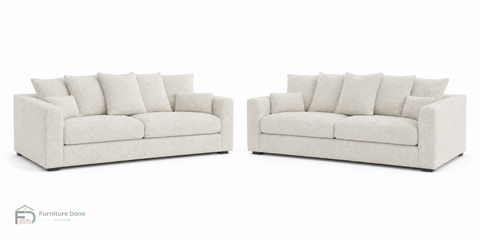
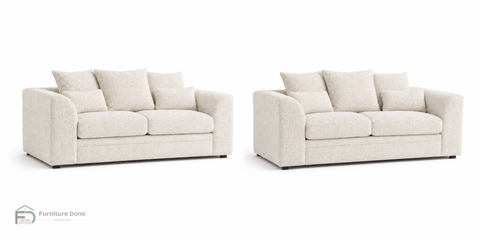
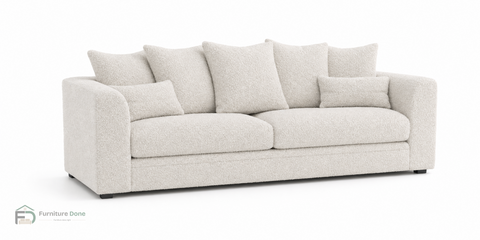
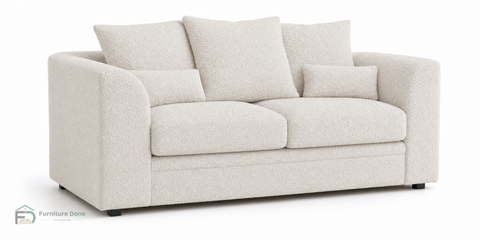

U shaped sofas: how to measure for one, and how ours compare
Share
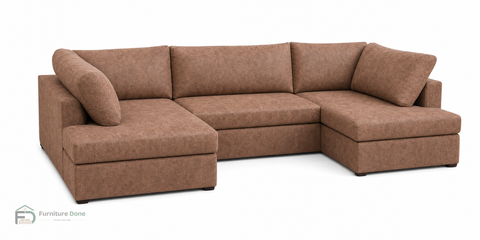
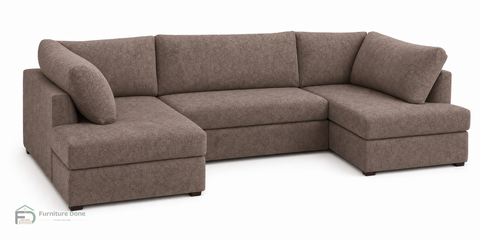
A U shaped sofa has a chaise at both ends, so you get seating down three sides of a room instead of two. It suits the room where the sofa is the room — family film nights, an open-plan space where the seating has to do the job a wall would otherwise do, or a snug you want people to sink into rather than perch in.
It is also the shape that most often goes wrong on measurements, so this guide starts there: how to measure for a U shaped sofa, and then how our two U shapes — the London and the Bishop — actually differ. Both are made to order in the UK, and both come in the same four fabrics. Prices are on their own product pages; this guide is about fit and fabric.
A U shape suits you if you can leave the back and both returns clear of doors and walkways, and if you regularly seat more people than a single sofa takes. If you need to walk across the middle of the room, or the space is a tight rectangle where the sofa has to tuck into two walls, a corner sofa is the easier shape and there is no shame in choosing it. If you are still deciding between the two shapes, L shaped or U shaped sofa walks through which one suits your room.
Will it fit?
This is the honest first question, and it is worth answering before you get attached to a fabric. Our two U shapes are a long way apart on size.
- The London U Shape is 279 cm wide, with a 159 cm chaise at each end.
- The Bishop U Shape is 330 cm wide, with a 194 cm chaise at each end — 51 cm wider across the back, and 35 cm further into the room down each side.
The width is the back wall measurement. The chaise length is how far the sofa reaches out into the room from that back wall, and it is the figure people forget. On the Bishop that is nearly two metres down both sides, which is what turns a room into a seating area — and what eats a walkway if you have not planned for one.
Both sofas sit at the same seat height, 45 cm, with a seat depth of approx. 55 cm, so they feel similar to sit on even though their footprints are not. The London stands 89 cm tall at the back, the Bishop 85 cm.
Three practical points on measuring.
- A U shape needs clearance on three sides. Mark the full footprint out on the floor with tape — back wall plus both chaise lengths — and then live with it for a day before you order. It is the cheapest way to find out that a door no longer opens.
- Measure the route in, not just the room. Doorways, the hallway, the turn at the bottom of the stairs — a U shape's chaises make it a wide, awkward load to bring in.
- Neither of these is handed. Both are symmetrical, so there is no left-hand or right-hand version to get wrong — the chaises return forward equally at both ends.
Our measuring guide has the dimension drawings for both sofas, along with a step-by-step route check for getting furniture into a room. If it is a corner sofa you are weighing up instead, how to measure your room for a corner sofa covers that shape specifically.
The two U shapes we make: London vs Bishop
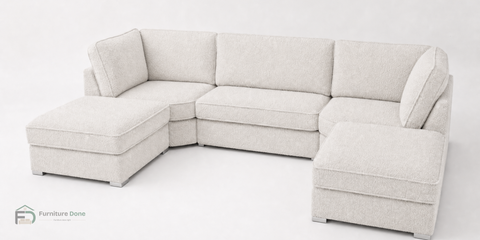
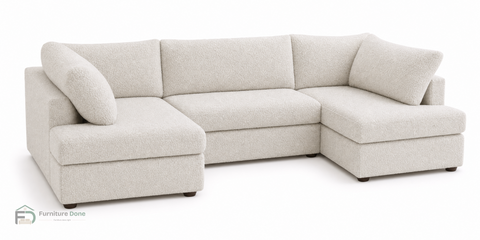
The London U Shape Sofa is the contained one. Each chaise is closed on its outer side by a low, plain square arm panel, so the shape reads as a defined block with an edge to lean against at both ends. It sits on a plain low plinth with small dark tapered feet, and there is no studding, tufting or piping anywhere on it — a quiet, square silhouette.
The Bishop U Shape Sofa is the open one. Both chaises are armless and open at the front, so you can lie the full 194 cm without an arm in the way. The corner and chaises form one continuous seat platform with no gap, step or break across it. Self-piping runs along every cushion edge and base seam, which gives the surface a defined outline, and it stands on brushed chrome block feet.
So the choice is not really a spec comparison. It is whether you want an arm at each end or not.
| London U Shape | Bishop U Shape | |
|---|---|---|
| Overall width | 279 cm | 330 cm |
| Chaise length (each end) | 159 cm | 194 cm |
| Height | 89 cm | 85 cm |
| Seat height | 45 cm | 45 cm |
| Seat depth | approx. 55 cm | approx. 55 cm |
| Chaise ends | Closed by a low square arm panel | Armless, open at the front |
| Feet | Low plinth, small dark tapered feet | Brushed chrome block feet |
| Fabrics | Teddy Bouclé, Plush Velvet, Faux Leather or Dapple, 26 colours | Teddy Bouclé, Plush Velvet, Faux Leather or Dapple, 26 colours |
| Delivery | Typically 1–2 weeks to mainland UK | Typically 1–2 weeks to mainland UK |
Both are made to order and made in the UK, and the seat cushions on both are fibre-wrapped foam cores.
Which one should you choose?
Start with the room, not the sofa.
- A narrower room, or a tight route in, points to the London. At 279 cm across with 159 cm returns it asks for less floor in every direction, and the closed arm panels mean it reads as a tidy block rather than sprawling. If you are working around a doorway, a radiator or a walkway you cannot lose, the smaller footprint is the one that survives the tape test.
- A larger, open-plan room points to the Bishop. At 330 cm across with 194 cm returns it holds the middle of a big space, and the armless chaises let people stretch out down the full length of either side. In a room with space to spare, the London can look as though it is hugging one wall; the Bishop is happy floating.
- If both fit, decide on the ends. Some people want an arm to lean on — that is the London. Others want armless chaises they can lie the full length of, and one unbroken seat platform across the whole shape — that is the Bishop.
Neither is the right answer in the abstract. Measure first, then pick the one whose ends you prefer.
Which fabric?
Both sofas come in the same four fabrics — Teddy Bouclé, Plush Velvet, Faux Leather and Dapple — in the same 26 colours, and every one is fire-retardant treated and pet-friendly. Teddy Bouclé is a short, dense bouclé-style weave in White, Grey or Pink. It is a matt, textured surface, so it reads as one even colour across a large shape and it is forgiving about seams and panel joins — useful on a sofa this size. If you want the detail, what is bouclé fabric explains the weave, and bouclé sofa pros and cons sets out both sides for a real household.
Plush Velvet is a smooth, short-pile velvet in fifteen colours. The pile catches the light, so the same panel reads a shade lighter or darker as you move around it — on a U shape, where you see three sides of the sofa at once, that shading is part of the effect rather than an inconsistency.
Faux Leather is a smooth, even surface with no weave or pile, in Black, Tan or Grey. Dapple is a plush velvet with a face flecked in two tones, in Cream, Oatmeal, Caramel, Chocolate or Black. Colour reads differently on every screen and in every room, so whichever way you lean, order a fabric sample and see it in your own light first.
Where to go next
Both sofas, with their full dimensions, colourways and photographs, are on our U shape sofas page. Take the tape measure round the room first, then choose the fabric — in that order, it is a straightforward decision.